WebFeatured
Presence
2026 Public MVP · Demo-grade liveness Solo Software Engineer
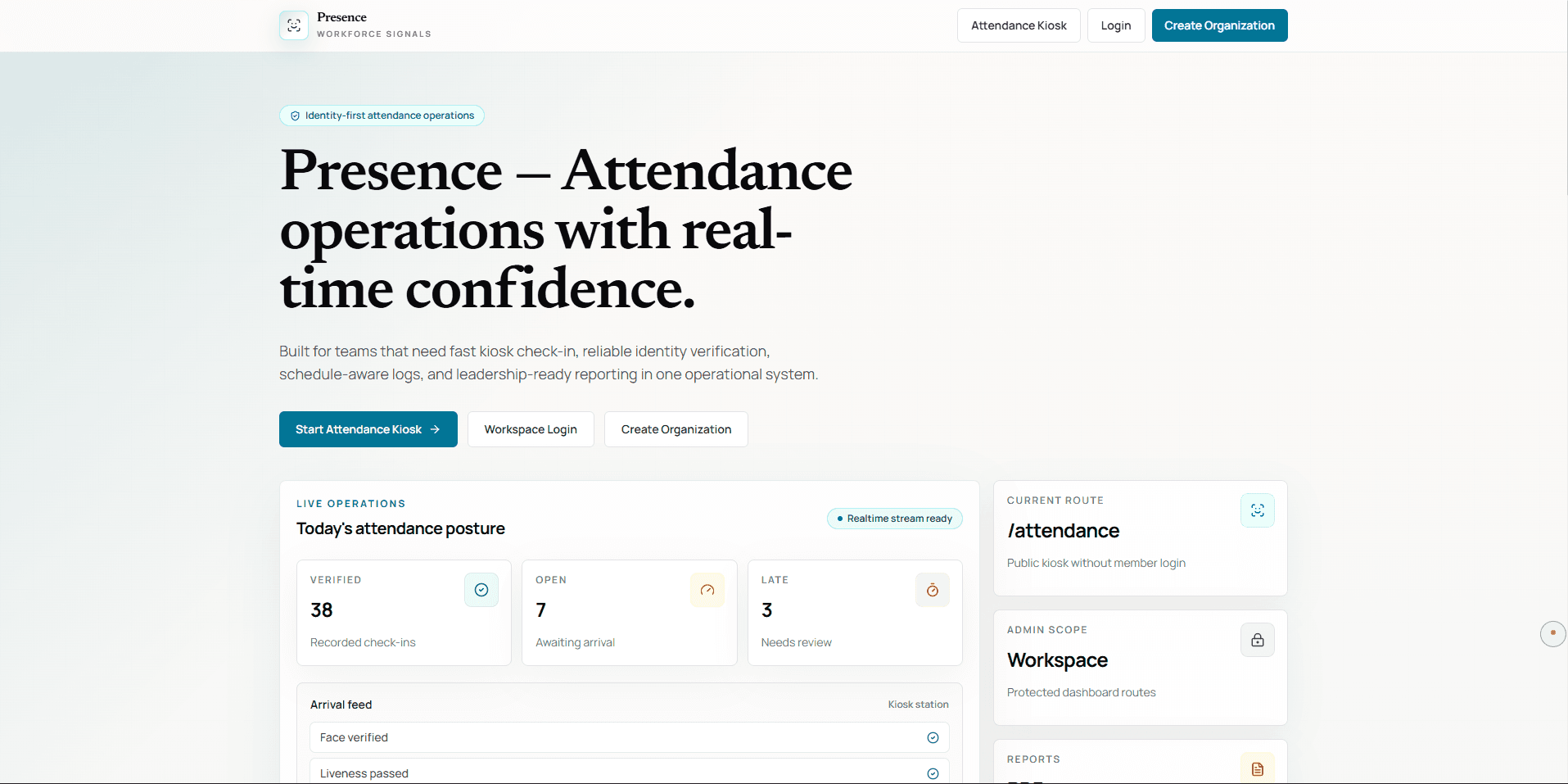
A workforce attendance platform with face verification, demo-grade liveness gating, server-side vector matching, shifts, realtime monitoring, and reports.
Next.jsTypeScriptTailwind CSSSupabasepgvectorTensorFlowface-api.jsWeb WorkersRechartsjsPDFFramer MotionVercel
What was broken?
Attendance systems often stop at forms or QR codes, which can be shared around. I wanted to test a more accountable flow where the check-in is tied to a real face, a live person, and the employee's assigned shift.
How I fixed it
I split the app into a public kiosk and an admin workspace. Face descriptors are extracted in the browser, matched server-side through Supabase pgvector RPCs, then written through protected server routes after liveness and shift checks pass.
What it can do
- Browser-side face embeddings
- Demo-grade head-movement liveness gate
- Server-side pgvector face matching
- Shift and schedule management
- Realtime attendance dashboard
- Monthly PDF report export
The stack that shipped it
Next.js keeps kiosk, admin, and server routes in one codebase. Supabase gives Auth, Postgres, Realtime, and pgvector; TensorFlow plus face-api.js handles recognition without sending raw images to a third-party model.
What changed
A public MVP demonstrating browser face embeddings, server-side pgvector matching, shift checks, realtime monitoring, and PDF reports. Head-movement liveness is demonstration-grade and has not been validated as production anti-spoofing.
What I learned
I learned that face recognition is mostly an operations problem: calibration, duplicate checks, security boundaries, and clear feedback matter as much as the model itself.